
Voting rights, the electoral roll and voting cards
Published: 17 June 2026
Here’s an introduction to when voter’s right to vote is established, how we produce electoral rolls, and how we send voters information about things such as their right to vote.
The right to vote in general elections
You must be at least 18 years old on election day in order to have the right to vote. There are a number of other requirements that must also be fulfilled, depending on the election in question. Information about the right to vote in all of the various elections is available on the Swedish Election Authority’s website, val.se. You can also find out about how Swedish citizens living abroad can get on the electoral roll.
The right to vote and voting cards – Swedish Election Authority (in Swedish) External link.
The right to vote is determined 30 days before election day
An individual’s right to vote is determined 30 days before election day with the help of the details in the Swedish Population Register, which is managed by the Swedish Tax Agency. This date is known as the qualification date.
What do the regulations say?
Chapter 5, Section 1 of the Swedish Elections Act states that the electoral rolls must be based on the details in the population registration database 30 days before election day, in accordance with Swedish legislation (2001:182) on the processing of personal data in the Swedish Tax Agency’s population registration activities, and in the Swedish Real Property Register in accordance with the Swedish Real Property Register Act (2000:224).
Expatriate voting cards for Swedish citizens living abroad
The Swedish Election Authority sends a preliminary voting card in paper to all Swedish citizens living abroad who are eligible to vote, 50 days before election day at the latest.
Those Swedish citizens living abroad who have a digital mailbox (Kivra, “Min myndighetspost” or Billo) also receive their voting card digitally 45 days before election day.
Expatriate voting cards are preliminary
Since expatriate voting cards are issued before the electoral roll is finalised (it’s finalised on the qualification date, 30 days before election day), the right to vote is stated on these voting cards on a preliminary basis and may be subject to change.
This might be the case if, for example, a Swedish citizen who has been living abroad is registered in Sweden again – after their expatriate voting card has been sent to them, but before the qualification date.
Addresses are retrieved from the Swedish Population Register
The Swedish Election Authority retrieves voters’ names and addresses from the Swedish Population Register about 75 days before election day. If a Swedish citizen living abroad wants to remain on the electoral roll, they must notify the Swedish Election Authority every 10 years of any change of address, or confirm that they wish to be included.
Details included on a voting card
An expatriate voting card states the voter’s name, their right to vote, and the electoral district in the Swedish municipality where they were last registered. An expatriate voting card does not state the voter’s electoral roll number because this number is assigned when the electoral roll is finalised.
If there are places where the voter can vote and/or receive postal voting materials in their country of residence/that they are visiting, the relevant contact details and websites are stated on the back of their expatriate voting card. Visiting addresses are not included. Voters are advised to visit swedenabroad.se (the official website for Sweden’s embassies and consulates) or contact the relevant Swedish mission abroad directly. Information about voting locations and ordering postal voting materials is also available on the Swedish Election Authority’s website, val.se.
Postal voting materials are included in each consignment
Postal voting materials are sent out with each expatriate voting card. A Swedish citizen living abroad can then choose whether to vote by post, at a mission abroad, or in Sweden.
Voting cards: voting abroad
All voters who can prove their identity must be given the opportunity to vote. Various types of voting cards may be used for voting from abroad:
- A voting card is sent to each voter listed in the Swedish Population Register. The voter’s electoral roll number is printed on their voting card.
- A duplicate voting card is a copy of a voting card, which is printed out from Valid (the IT-system used for managing elections).
- An expatriate-voting card does not include the voter’s electoral roll number, since this type of card is issued before the electoral roll is finalised.
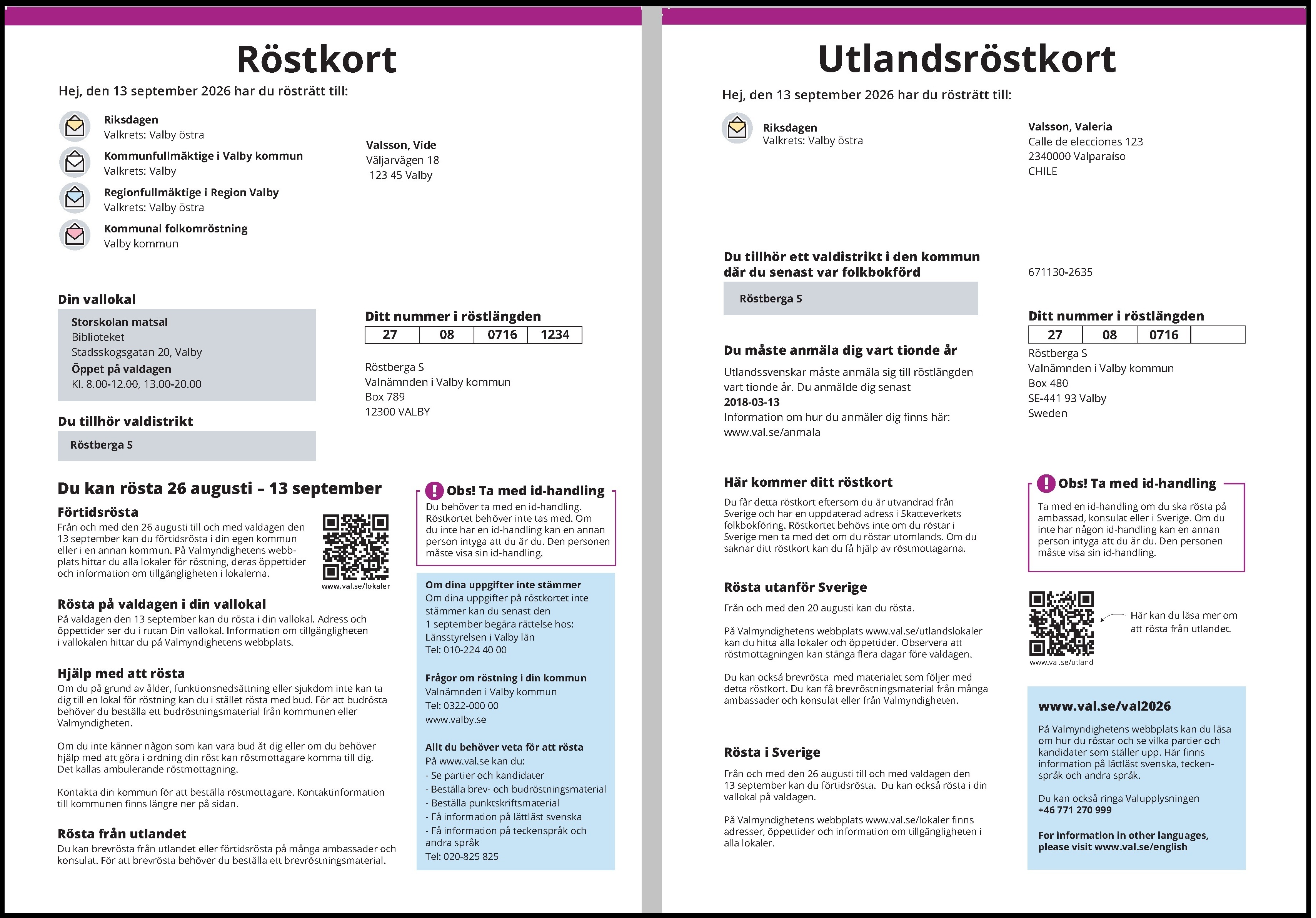
Paper voting cards: “Röstkort” for use in Sweden, “Utlandsröstkort” for use abroad; and a duplicate voting card (“Dubblettröstkort”).
Voting cards during vote reception
- A voting card or duplicate voting card should be used for vote reception if possible. The voter’s electoral roll number ensures secure and effective vote processing by the Swedish Election Authority and Sweden’s municipalities.
- An expatriate voting card can be used as a secondary option. The voter’s electoral roll number will then be added when their vote is received by the municipality in which they are registered.
- If the voter doesn’t have a voting card, and a duplicate cannot be printed out, the polling staff can fill in an address card.
Searching for details of a voter’s right to vote in Valid
Search the electoral roll for the relevant election
In Valid, the menu Sök i valtillfällets röstlängd ("Search the electoral roll for the relevant election") appears first. It appears several months before an election, and is a preliminary electoral roll. In this register, you can check an individual’s preliminary voting rights.
These details are retrieved from the Swedish Population Register and are updated on a daily basis. Changes can be made to these details until the right to vote qualification date. The right to vote qualification date is 30 days before election day. Check the calendar for the exact date.
Check the “Duplicate voting card” menu for right to vote details
After the qualification date, when the right to vote has been determined, the menu Dubblettröstkort (Duplicate voting card) will appear in Valid. The same details are included under this menu as under Sök i valtillfällets röstlängd ("Search the electoral roll for the relevant election"), but under Dubblettröstkort ("Duplicate voting card") you can also create and print out duplicate voting cards.
Details shown in search results
The following details are always displayed among search results:
- personal identity number
- name
- address
- the voter’s electoral district
- the voter’s right to vote
- the property at which the individual is registered
citizenship
After the qualification date, the voter’s electoral district and the electoral roll number is also displayed.
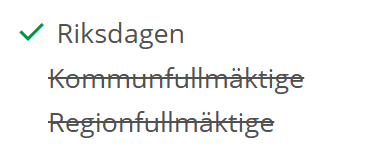
Example: details displayed for a person who has the right to vote in elections to the Riksdag, but not in municipal and regional council elections.
Disclosing details
Only disclose the details that someone requests. If someone asks for details relating to another person, you are allowed to disclose them.
You will not be able to access any personal data for individuals with protected identity. If you search for an individual with protected identity, you will be notified that “SKYAD” authorisation is required in order to continue. This authorisation is not available outside of Sweden, contact the Swedish Elections Authority for further questions. Only explain that a voter’s details are confidential if someone enquires about this.
Search results: special cases
More detailed outlines of various search results are provided below.
Date of immigration – resident but not a citizen
The date of immigration is displayed in the electoral register for non-Swedish citizens who are resident in Sweden. The date of immigration is the date on which an individual is listed in the Swedish Population register.
Citizens of an EU country, Iceland or Norway who are listed in the Swedish Population Register before the qualification date have the right to vote in regional and municipal council elections.
Citizens of other countries (apart from Sweden) who have been listed in the Swedish Population Register for three consecutive years before election day have the right to vote in regional and municipal council elections.
Date of emigration – Swedish citizen living abroad
The electoral register shows the date of emigration for Swedish citizens living abroad. The date of registration to the electoral roll is also shown if the person registered after emigrating.
If the person emigrated or was added to the electoral register in the past 10 years, they will receive an expatriate voting card.
If the person emigrated or was added to the electoral roll more than 10 years ago, they will not be added to the electoral roll automatically. However, the person can be added to the electoral roll and gain the right to vote by voting at an early voting location in Sweden (they can even do this on election day), or by voting from abroad by post or at a Swedish embassy or consulate. The person will then remain on the electoral roll for a further 10-year period (the Swedish Election Authority informs the Swedish Tax Agency of who should be registered on the electoral roll).
If the person contacts you before the qualification date, refer them to the Swedish Tax Agency so they can request to be added to the electoral roll. The voter must fill in a form for this matter available at the Swedish Tax Agency. Swedish citizens living abroad who are on the electoral roll for the elections can vote at their assigned voting location if they’re in Sweden. Swedish citizens living abroad must also notify the Swedish Tax Agency of their current address if they have have moved, so that they can receive their international voting card.
Voting in Swedish elections – Swedish Tax Agency (in Swedish) External link.
Protected identity
The electoral register includes individuals with protected identity whose personal data in the Population Register is subject to confidentiality. Only Swedish Election Authority or County Administrative Board employees are allowed to print duplicate voting cards for voters with protected identity. You can still receive a vote from a person with protected identity. In this case, use an address card and write the voter’s name and personal identity number on it. If the voter has questions or wants a voting card, ask them to contact the Swedish Election Authority.
Municipal referendums held in certain municipalities
Some municipalities hold municipal referendums at the same time as the elections to the Riksdag and regional and municipal councils. If someone living in such a municipality is entitled to vote in the municipal referendum, this will be indicated in their details in Valid and on their voting card.
Unidentified person – they have no right to vote
If Valid does not recognise an individual’s personal identity number, it’s because they are not listed in the electoral register and therefore do not have the right to vote. This could be because the individual is under 18 years of age, has died, is a Swedish citizen who has never been listed in the population register, or is a citizen of a country other than Sweden and has lived in Sweden but subsequently emigrated.
För att kunna se filmen på denna webbsida, måste du acceptera kakor för statistik.
Frequently asked questions
Is someone who has a coordination number allowed vote?
No. A voter must have been listed in the Swedish Population Register at some point to be given a personal identity number and added to the electoral roll. It’s not sufficient just to have Swedish citizenship.
The person voted in the most recent elections. Are they still on the electoral roll?
When someone’s 10-year voter period ends, they are removed from the electoral roll. This applies regardless of whether they have voted in previous elections. A person is not necessarily on the electoral roll just because they voted in previous elections.
But even if they’re no longer on the electoral roll, they can still vote in the elections. Their vote will then count as a request to be added to the electoral roll. The Swedish Election Authority needs to receive their vote no later than 12 September (the day before election day) in order for them to be added to the electoral roll and for their vote to be counted in the election. If we receive their vote later than that date, they will be added to the electoral roll for a new 10-year period, but their vote will not be valid for the current elections.
A postal vote only counts as a request to be added to the electoral roll if the 10-year period has ended and they’re no longer on the electoral roll. If the person is still on the electoral roll and they vote by post, their current voter eligibility period will not be extended by a further 10 years.
A voter has not received their voting card and is wondering whether they have the right to vote and are on the electoral roll.
We retrieve voters’ address details from the Swedish Population Register, which is managed by the Swedish Tax Agency. If the voter hasn’t received their voting card, it might be because the voter does not have their address up-to-date registered.
The voter doesn’t need to bring their voting card with them when they vote. The voter only needs to prove their identity in order to vote.
If they would like a duplicate voting card, they can request one from the Swedish Election Authority or a Swedish mission abroad, who can email it to them. The voter can also request postal voting materials from the Swedish Election Authority, and – in some cases – from a mission abroad.
Does a Swedish citizen born abroad have the right to vote?
If the person has never been listed as a resident in Sweden, in the Swedish Population Register, they cannot vote in Swedish elections.
Can the details registered on the electoral roll be changed after the qualification date?
Individuals can ask for corrections to be made to the electoral roll by the County Administrative Board, but only if the information that one wants to change is something that was incorrect at the time of the qualification date. Corrections must be requested at least 12 days before election day. If someone believes that the details registered on the electoral roll are incorrect, you can refer them to the County Administrative Board.
What is the code on the window envelope?
This code enables the vote to be linked to the voter’s assigned voting location.
Missions abroad do not use this code. The link will be made between the voter’s vote (the window envelope) and the voter’s assigned voting location when their vote arrives in Sweden.
During early voting in Sweden, handheld scanners are used to link the vote to the voter during vote reception, using Valid.
The established link only includes details of where the vote should be sent – not how or what the voter has voted.